You can’t blame end of life boat owners for abandoning their boats when there is no realistic alternative
Wreck Free Fal and Helford volunteer Jake Burnyeat considers the local policy solutions to tackling the problem of abandoned boats.
3/27/20264 min read
My post content
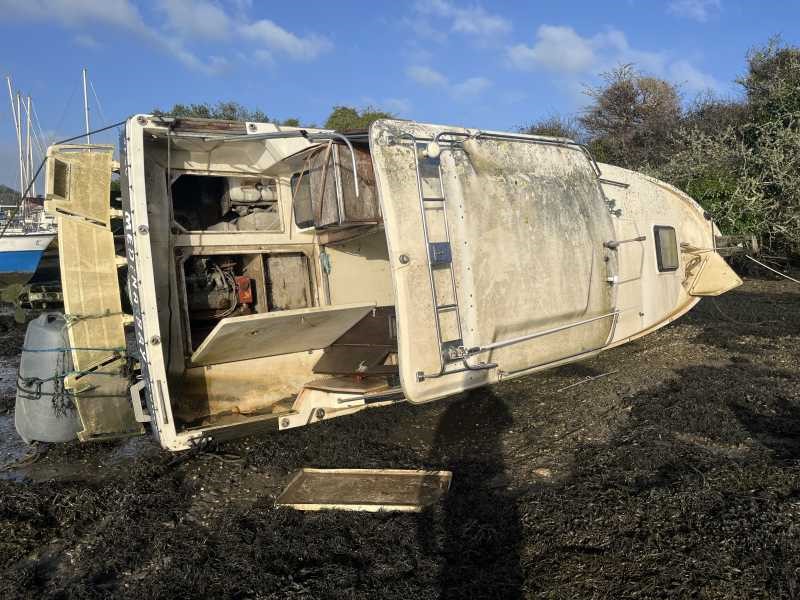
There are around 5,000 moorings on the Fal and Helford Estuaries. That’s probably over 30,000 tonnes of mostly GRP boats which at some point will reach the end of their lives. A paper commissioned by Government in 2023 looked at the scale of the problem across Europe and concluded that 1-2% of boats are reaching end of life now but this could rise to up to 10% by 2030. If that’s the case, the Fal and Helford could soon be facing a problem of hundreds of boats a year being abandoned. The majority of boats being abandoned at the moment are small GRP boats from the 1970s and 80s. Boats have got bigger and production volumes increased since then.
The problem is exacerbated by rising costs of boat ownership, especially mooring and yard fees. Boat owners stuck with a boat they can’t afford to keep and can’t sell are left with a difficult problem. It can cost thousands of pounds to scrap a boat responsibly so it is no wonder they get abandoned up a creek, leaking GRP fibres, oil, fuel and toxic paints into the marine environment.
Cornwall Harbours has committed £165,000 over the next 3 years to salvage and scrap end of life boats which have been abandoned by their owners. Clearing up abandoned end of life boats is a mounting problem for Cornwall Harbours who have already spent £150,000 over the last few years removing 85 abandoned boats. Cornwall Harbours have led the way in establishing powers to clear and scrap abandoned boats that are a risk to navigation or the estuary environment, and recover the cost from owners. However, it can be difficult proving ownership as the UK has no compulsory registration scheme for boats. In many cases, end of life boat owners won’t have the money even if the authorities could prove ownership.
Cornwall Harbours is self-funded out of harbour revenues including mooring fees so ultimately the cost will fall back on boat owners.
The Fal and Helford are complicated by the fact that there are 3 harbour authorities covering some but not all of the Fal estuary and no authority covering the Helford. The more Harbour Authorities clamp down on end of life boats in their areas, the more the problem is pushed to unregulated areas of the estuary.
You can’t really blame end of life boat owners for abandoning their boats when there is no realistic alternative. A policy which relies on end of life boatowners paying the cost of scrappage will fail. It can cost thousands of pounds to scrap a boat responsibly and in most cases they won’t have the money. Without a robust compulsory registration scheme like we have for cars (and France has for boats), it is very difficult to prove ownership.
For domestic waste we have rubbish collection funded by council tax. For electronic goods we have the WEEE directive which recovers the cost of recycling from producers. We need something similar for boats. It makes no sense to have an industry putting more and more boats onto the water with no policy for dealing with them at the end of their lives.
France has a national policy solution – a combination of compulsory boat registration and free at use scrappage at 35 licensed yards around the coast, funded by a producer levy and national boat tax. It’s probably not perfect but the French have succeeding in scrapping over 11,000 boats since 2019.
There is unlikely to be any UK national policy forthcoming anytime soon. Truro and Falmouth MP Jayne Kirkham and Lord Teverson have each tabled parliamentary questions on end of life boats and received responses referring to studies commissioned years ago which haven’t led to further action. So is there a local policy solution in the meantime?
There are some key principles that could form a policy solution, and a range of ways of achieving them.
Firstly, the cost of scrapping an end of life boat should be spread over its life. It is a cost of ownership that all owners should contribute to. The cost can’t fall on the end of life owner who will be worst placed to pay. Nor should the cost fall on the general tax payer or be left to landowners.
France achieves that principle through a national boat tax, but it could also be achieved through moorings fees, harbour dues or a local contribution scheme.
Wreck Free Fal and Helford estimates the cost of funding a local free at use scrappage scheme on the Fal and Helford would be a around £30 per mooring per year. The cost of clearing up wrecks in self-funded harbour authority areas is already born by boat owners via mooring fees.
Secondly, there needs to be an easy and no or low cost option for boat owners, boat yards, authorities and landowners to get rid of end of life boats. Without that boatowners will continue to walk away from their boats and authorities and landowners will continue to argue about who is response for dealing with wrecks. Whoever ends up paying, it is a lot cheaper to scrap an end of life boat before it becomes a wreck and a legal quagmire.
France achieves that through their national free scrappage scheme. The same could be achieved through a local scheme funding licensed yards to scrap boats, harbour authorities offering to take unsellable boats off their owners hands or an annual amnesty.
Thirdly, better deterrents which could include compulsory boat registration, education, enforcement of harbour bylaws and environmental regulations. Deterrents will only work if they are backed by providing a viable alternative.
France has national compulsory boat registration and it doesn’t put people off boat ownership. Local and voluntary registration schemes would help but ultimately can only be relied on if they are a legal requirement and are as robust as road vehicle registration.
All this comes down to:
Boat owners need an easy route to doing the right thing.
Authorities need the powers to go after boat owners who don’t.
Ultimately, end of life boats are a national problem and we need national policy solutions. For that we need the relevant industry and statutory bodies to take a lead, recognise and quantify the scale of the problem now and to come, and progress policy solutions.
The RYA, British Marine, British Ports Association, Marine Management Organisation, Maritime and Coastguard Agency, Environment Agency, Dept of Transport and DEFRA all have a role to play. It is also a strategic issue for foreshore owners including Crown Estate, Duchy of Cornwall and Lancaster and National Trust.